Senators from both parties and experts from various fields gathered to tackle the Florida condo crisis — but warned struggling owners that there is no silver bullet for rising costs and that deadlines are not likely to be extended.
|
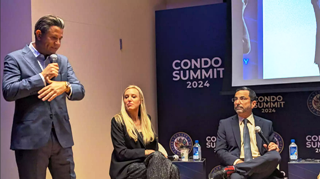
State Senator Jason Pizzo (D.) speaks to a panel at the 2024 Condo Summit |
The state requires associations to keep
financial reserves that could be used for future building
repairs, but had allowed HOAs to waive that responsibility.
When the new laws went into effect, that loophole closed,
and associations scrambled to fill their reserves, leading
to rising costs for owners. In response, condo sales have
plummeted as owners try to offload their units to avoid
higher fees.
Pizzo said that the goal of the regulations is to give
owners a clear snapshot of the structural and financial
health of their buildings. He also intimated that some of
the burden for the increasing costs is on the owners of
these condo units.
“I have sympathy, but it doesn't rise to the level of
empathy,” he told WLRN. “Surely you had a home inspection
because you probably got financing, and it told you about
the appliances, and the condition, and the useful life
remaining, and all of these things… you did this for the
interior of your unit, but you didn't do it for the building
that your unit is sitting in?”
He even invoked the Champlain Towers tragedy as an example
of owners who should have done more to ensure their building
was safe.
“The 98 people of my constituents who died in Surfside, are
they partly to blame for not asking the tough questions that
put themselves in peril? Probably. I don't know,” he said.
Surfside is in Pizzo’s district.
Despite Governor Ron Desantis making a public call for a
special session this year, the issue won't be discussed in
the legislature before the regular session that convenes
March 4, 2025.
“Lack of a special session is not a lack of importance of
the issue. There was not a game plan, there were no
proposals put forth that were vetted,” said Bradley, “This
is number one on our mind, and you don't have a special
session if you don't have a bill to pass or solutions to
implement.”
The summit hosted discussions featuring industry experts
from a wide variety of fields who were able to voice their
concerns on the state of condominiums in Florida. This
included financial advisors, HOA representatives, and risk
management experts.
“I wanted every professional from all the different
industries across disciplines that affect condos to come and
share what's on their mind, what they are seeing on the
ground in terms of implementation, and offering solutions of
ways that we can do it better,” said Bradley.
Some of the concerns voiced by those experts included the
increased frequency of 100 and 250-year storm events due to
climate change. Also noted was the Florida Building Code
regulating the storm readiness of windows, but not the
tracks the windows sit on, which could allow water to damage
buildings.
Bradley said that legislative solutions could focus on
insurance agencies, claiming that a majority of the cost
increases condo owners are facing are from rising insurance
rates.
“I think that they solve themselves together. When you
harden the building, when you make sure that the building is
structurally stable and doesn't have deficiencies, then you
will find that your insurance rates go down,” she said.
But any solutions are not likely to include extension on
deadlines for reserve funding and structural work. Pizzo
said he is not willing to do so because of the safety risks
associated with the aging buildings.
“I will tell you that we're doing a disservice — and a
dangerous one at that — if we just continue to push
deadlines back without justifying why,” he said, “Father
time can't be slowed down and mother nature is undefeated.”
Pizzo and Bradley both said that the issues facing condo
owners would need continued bipartisan cooperation to be
solved.