The Kalmia Condominiums in Clearwater
wasn’t Ronni Drimmer’s dream retirement destination.
She bought a two-bedroom unit there for her mother in 2001
but ended up moving in when her mom died 18 months later.
|
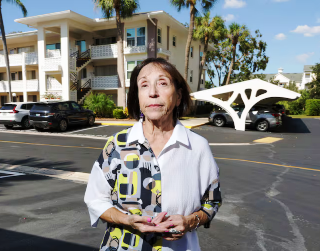
Ronni Drimmer, President of the Condominium Association Board for building #5 at the Kalmia condominium complex in Clearwater, said many condominium residents fear they may have no choice but to sell due to new building safety requirements, skyrocketing insurance costs and damages from this hurricane season. |
“A lot of these buildings are already
dead man walking,” said Joe Hernandez, an attorney with the
Miami law firm Bilzin Sumberg who specializes in condo
terminations. “There’s going to be a lot of people that will
pay much higher costs and sometimes to the point that they
can’t afford to stay in Florida.”
After the Champlain Towers South condo collapsed in Surfside
three years ago, killing 98 people, the Florida Legislature
unanimously passed strict building safety guidelines in
hopes of preventing another tragedy.
At the time, the legislation was applauded as a bold but
necessary step toward bringing aging condos up to code,
especially those like Champlain Towers, where the board had
continuously underfunded reserves and postponed major
repairs to keep costs down.
As the end-of-year deadline approaches, both condo owners
and legislators are speaking out about the devastating
financial toll these regulations could have, even at
buildings that have been deemed safe.
Seniors stand to lose the most, said 78-year-old Connie
Weitlauf, another resident of the Kalmia Condominiums. “When
you’re getting old and you’re by yourself and you’re on a
fixed income and you really can’t afford a place to live,
it’s just scary,” she said.
Before the Surfside-inspired reforms, only two counties
required regular inspections for condos. Condo boards had
near complete control over how much they saved and what
repairs they made.
Now, all condo buildings 30 years and older and three
stories and higher must be inspected every 10 years to
determine if they are structurally sound. A mandatory
reserve study will dictate how much condo boards must save
each year to cover routine maintenance.
Hernandez said there will be a “rude awakening,” and many
older condos will not survive. Developers are already
looking for opportunities to buy these properties and
rebuild.
Still, he said, the changes are intended to make condos
safer and more financially stable.
“This was always the norm in the commercial building world,”
Hernandez said. “It’s now time to bring condominium
buildings up to that same standard. … They need to be
professionally run.”
To Drimmer, who is the condo board president for her
building, some of the requirements feel like “overkill.”
Her board has been responsible, she said, saving money each
year for things like the roof and elevators. The engineer
who inspected her building found no signs of dangerous
conditions.
Still, they’ll be forced to set aside funds for everything
from electrical to plumbing, leading to much higher
maintenance fees. Drimmer’s monthly bill will go from $475
to $675, but the exact costs will differ per unit.
“It should be more targeted to the people that are actually
the bad actors and didn’t put money away,” Drimmer said.
“We’re not stupid. We’ve managed to figure things out all of
these years.”
The bill is coming due at a time when Florida’s insurance
market faces unprecedented challenges. Insurance premiums
for condo associations across the state increased more than
70% on average since 2022, according to data from NSI
Insurance Group, Florida’s largest privately owned insurance
firm.
Rates will continue to rise, especially after this year’s
devastating storm season, said Oscar Seikaly, CEO of NSI
Insurance Group. Older condos will be impacted the most.
“If you have no money in the bank and you’re struggling to
collect from unit owners who are retired and on a fixed
income, then you know there’s an issue there,” he said.
“Insurance companies are paying close attention to that.”
Drimmer’s building is covered by Citizens Property
Insurance, the state-run insurer of last resort. This year,
Citizens told the board it would terminate coverage unless
the building got a new roof. Drimmer claims the roof
recently had about $60,000 worth of restoration work and is
still under warranty for five more years.
Drimmer said she’s disappointed by the lack of urgency from
the same lawmakers who rushed to regulate condos without
considering the unintended consequences.
When she was invited to speak at a September condo
roundtable hosted by Gov. Ron DeSantis, she encouraged him
to call a special session to tackle the oncoming crisis.
DeSantis told her that the Legislature would come up with a
solution for condo owners but did not commit to a specific
timeline.
Over the summer, Senate President, Kathleen Passidomo,
R-Naples, rejected calls for a special session.
Nick DiCiglie, the state senator for District 18, where
Drimmer lives, said there will be plenty of time to fix
things once legislators returns to Tallahassee in December
ahead of the regular session.
But for some condo owners, the damage has been done.
In the Tampa metro area, monthly fees for condo owners shot
up more than 17% year over year, according to a July report
from the real estate firm Redfin. Fees increased more than
16% in Orlando and Fort Lauderdale and almost 13% in West
Palm Beach.
In South Florida, investors are buying out whole condo
communities, the Miami Herald found. Hernandez said he
expects that trend to accelerate as owners become more
desperate for a way out.
“Eventually, people are going to realize that it’s not worth
staying in a building that costs more and more to maintain
yet the value continues to decrease,” he said.
After months of waiting to see how things might shake out,
Weitlauf has decided she can’t afford to stay in the
one-bedroom unit she bought three years ago.
She’s not sure where she’ll go. None of the apartments or
other condos she’s looked at in the area fit her budget. She
may move to Idaho to live with her son
“I’m very comfortable here,” she said. “I thought this would
be it for me. Now I’m just hoping I break even when I go to
sell.”