A condo association at
a pair of luxurious beachfront towers in Bal Harbour is
suing the companies that own and manage the common areas,
alleging that negligence and poor maintenance has led to
safety risks including electrocution and the stability of
the parking garage.
The lawsuit by unit owners at the 12-year-old St. Regis Bal
Harbour Residences comes more than three years after the
collapse of the Champlain Towers South in Surfside, about a
mile south along the Atlantic shore.
|
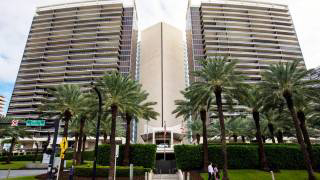
An exterior shot from Collins Avenue of people walking past the St. Regis Bal Harbour Resort, in Bal Harbour |
What the condo lawsuit alleges.
The association lawsuit alleges that the building owners
neglected crucial health, safety and structural repairs for
years in the common or “shared” areas that they’re
responsible for under condo bylaws.
“Urgent action is required to return the Resort to a safe
condition and protect the health of the residents,
employees, and guests at the Residences and Resort — as well
as the public at large,” the lawsuit said. “Without urgent
assessment and repair efforts, the consequences may be
catastrophic.”
The condo association requested on Nov. 7
that a judge force the building owners to pay for the
condominium association’s chosen experts to repair the
problems. The condo owners want the judge to order the
repairs before making a full ruling, Juan Morillo, partner
at Quinn Emanuel Urquhart & Sullivan, which represents the
North South Condominium Association, told the Miami Herald.
The claims mostly cover the residential towers, and include
allegations of widespread flooding in the parking garage and
inside several condos and the gyms. The suit says that
flooding has led to structural defects that include cracking
in the concrete pillars holding up the garage, and the
corrosion of steel supports in the complex. The owners “have
ignored widespread water intrusion throughout the Resort,”
the lawsuit alleges.
Fallout from the issues
The flooding has caused “extensive damage to structural
components of the Resort, including the parking garage where
portions of the ceiling are ominously held up by temporary
shoring posts; the Residences’ crumbling facades; the
life-safety systems, such as the perpetually flooded and
moldy egress stairs that are crucial to evacuation during a
fire, hurricane, or other emergency,” the lawsuit said.
The suit also mentions defects in electrical systems,
including the fire sprinkler system and exposed electrical
wires that lay wet and corroded, and flooding elevators.
The lawsuit calls building owners’ behavior willfully and
grossly negligent, saying that property bylaws hold them
responsible for shared or common spaces. It asks for a
judicial order requiring the defendants to inspect the
property, ensure all the needed repairs are made in a timely
fashion and pay for all costs.
Other problems cited in the lawsuit include chipped and
crumbling building facades leading to one warning posted
outside the towers for residents: “CAUTION: Please Watch For
Possible Falling Debris.” Colonies of mold are also growing
throughout the towers, found on condo walls, unit owners’
furniture and electronics, according to the suit.
How the St. Regis Bal Harbour Hotel is affected
While many of the problems affect the condo residents, some
also affect hotel guests, including a parking garage that
floods and the funding of a restaurant with association
funds, the lawsuit claims.
“There is widespread leakage through expansion joints, and
the under-slab drainage system is clogged and nonfunctional,
causing water to push up through the floor slabs,” the
complaint said.
The lawsuit also accuses the owners of financial
mismanagement, citing “improperly siphoned funds belonging
to the [Condo] Association and earmarked for crucial repairs
and used those resident funds to subsidize projects
benefiting the defendants — including a new luxury café at
the St. Regis Hotel.”
The suit says that more than $1.5 million that should have
been designated for maintenance and repairs instead went to
remodel the hotel café, La Gourmandise.
Former site of a landmark hotel
The St. Regis is on the site once home to the Americana
Hotel, which opened there in 1956. The Americana later
became the Sheraton Bal Harbour. The hotel was demolished in
2007.
The St. Regis Resort and Residences was completed in 2012.
The then-owner, Starwood Hotels & Resorts Worldwide, sold it
to ARTIC in January 2014.
Today, the St. Regis Resort and Residences consists of three
27-story towers with over 2 million square feet. One of the
buildings is the hotel, the St. Regis Bal Harbour Hotel, at
9703 Collins Ave.
Condos are in the other two towers. A two-story underground
parking garage connects the three high-rises.
The defendants in the St. Regis lawsuit
The St. Regis owners are Doha, Qatar-based ARTIC, a
hospitality and real estate investment firm. The subsidiary
of Al Faisal Holding, a Qatari company founded by H.E.
Sheikh Faisal Bin Qassim Al Thani, has investments in over
35 hotel or real estate properties worldwide, including the
W Miami in Brickell and the Crowne Plaza Times Square Hotel
in New York.
ARTIC owns the St. Regis through Seldar, a limited liability
Delaware company with principal base of business 9703
Collins Ave., Bal Harbour, site of the St. Regis Bal Harbour
Resort.
El Sayed, the chief executive of ARTIC, lives in Chicago and
is a director of the condo association, a reason that
plaintiffs claim he has known of the problems for years.
“Mr. El Sayed has knowingly and deliberately participated in
ARTIC’s obstructionist conduct and has at all times relevant
been at the helm of ARTIC’s wrongdoing at the Resort,” the
lawsuit alleges. “He is ultimately responsible for ARTIC’s
obstructionist conduct and its decision to place the
company’s bottom line over the maintenance and repair of the
Residential Unit Owners’ property.”
Polino lives in Miami and is USA director of operations for
ARTIC. He regularly attends Bal Harbour North South
Condominium Association board meetings. That’s in part why
the plaintiffs contend the building owners have known about
the issues.
Morillo, their lawyer, says ARTIC has received “hundreds of
complaints” from unit owners, but has shown “no real
concerted effort” to fix things, even with condo unit owners
paying the bill. But when gross negligence and willful
misconduct is shown, the costs become the responsibility of
the complex’s owners, Morillo said.
How officials started getting involved
In January 2022, a Miami-Dade Fire Rescue Department
official inspected the building. He then notified Bal
Harbour. Days later, a village official visited.
“During my walk-thru, I observed several areas of concern,”
village building official Eliezer Palacio wrote in a letter
to St. Regis Bal Harbour Resort obtained by the Miami
Herald. He told them of “structural damage I observed” and
“needed structural and electrical repairs.” He recommended
that the complex owner hire a professional inspector and an
electrical engineer to assess the problems and plan
compliance with Florida’s Building Code.
In March 2022, Kimberly Horn & Associates, a firm hired by
the complex’s owners, told Bal Harbour officials in a letter
that they found the condo buildings “structurally safe for
continual occupancy and use,” after visiting that month. It
recommended “isolated repairs” such as to the building’s
electrical system. It cited water intrusion, including in
the gyms in both condo towers, cracked concrete and corroded
steel supports. Later that year, unit owners were told
Kimberly Horn had hired a water intrusion expert.
But in January 2024, the condo association learned that
“nothing, or at least close to nothing, had been done during
the preceding two years since hiring Kimberly Horn,” the the
condo association lawsuit states.
Then at a July 29, 2024, meeting of the condo association’s
board, members were told Kimberly Horn was no longer working
for the complex’s owners. Polino, one of the defendants,
attended the meeting by video conference, but when asked
what happened, his “connection conspicuously disconnected,”
the lawsuit said. One person said there had not been “a
proper maintenance program in place for 12 years.”
In October, an independent expert hired by the plaintiffs
visited the complex. Benjamin Cornelius, an engineer with
New York-based LERA Construction Structural Engineer
International, arrived on Oct. 8 and Oct. 24.
His report, included in the lawsuit, found “severe,
widespread, ongoing water intrusion occurring at the complex
which appears to be due in large part to the deferral of
maintenance and inadequate repair efforts.” He said that
flooding had “damaged ... the structure ... and has resulted
in unsafe conditions.”
Delaying repair and maintenance in past years, the report
said, “has increased the scope of the repair work necessary
to restore the complex to a safe condition.”