Recent condo buyers like the Johnsons are likely to be the most affected by the fallout from the new law. Older buyers benefited from deferred repairs that resulted in lower fees. They also bought at a time before prices surged.
|
Damage at Building 5 of Villa Del Sol condominiums |
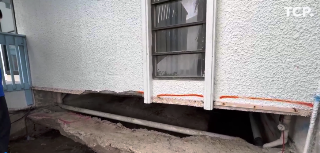
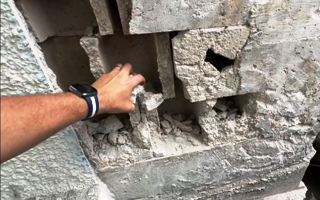
Conditions were so bad in three of the six buildings that he made a 911-type call to the county fire marshal calling for an immediate evacuation: The buildings were in danger of collapsing. He found:
-
Concrete so loose it fell apart when he touched it with his bare hands.
-
Exposed rebar that was disintegrating.
-
Quarter-inch plus cracks in many concrete sections.
Eight months earlier, his West Palm Beach-based firm, AB Plus Engineering and Restoration, had found issues that warranted the more detailed inspection that occurred that August morning. County officials moved quickly to issue an evacuation order. Villa Del Sol is located just north of the Jensen Beach Causeway.
|
Workers begin repairs Aug. 9 on three Villa Del Sol condominium buildings on Hutchinson Island that were deemed unsafe Aug. 8. About 11 residents evacuated from the structures in southern St. Lucie County. |
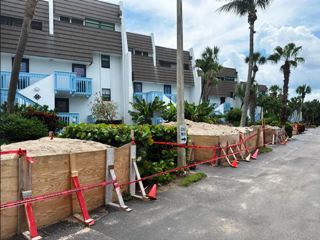
Repairs to his building may not be done
until at least April, according to a recent engineering
report.
And Johnson says the property management company has said
that the repairs could cost as much as $9.2 million to be
split among 72 homeowners. Johnson said he was given that
estimate of $9.2 million in costs from the property's
management and it would cost nearly $173,000 per homeowner.
|
Screen capture of video taken in August 2024 showing damage at Building 5 of Villa Del Sol condominiums in St. Lucie County. Three buildings there were evacuated. |
About 100 miles south in Broward County,
a court-appointed receiver is looking to sell off Heron
Pond, a 304-unit Pembroke Pines condo community, after city
officials determined the complex was so unsafe that everyone
had to evacuate by Aug. 29. Fences surround the
nine-building complex and signs warn people not to enter,
threatening anyone who does with trespassing charges.
Engineering reports found substantial water damage and
termite activity. Recently repaired sections showed new
signs of deterioration at the 36-year-old complex.
"This is so sad," said Edward Picon,
whose 83-year-old mother had to move in with his brother,
who lives in Weston. "The HOA collected money all these
years and did not do what they should have done — maintain
the complex."
Daisy Lee, a resident of the complex for the past 19 years,
said the city is helping people out by paying the first and
last month's rent and security for a rental but she said she
cannot afford to pay rent and also keep up with the expenses
on the unit she had to leave.
"It is just a matter of time before I become a homeless
person," she said.
The receiver presented an option to owners at Heron Pond —
sell or pay a $40,000 special assessment to make the
buildings safe. Most of the owners who participated in a
poll voted to sell. The receiver is preparing to do just
that.
Another evacuation order was issued in Fort Lauderdale after
inspectors concluded that the 18-unit Springbrook Gardens
condo was unsafe to live in. Residents left the building
Sept. 27, forcing them to find a new place on short notice.
State Rep. Vicki Lopez, R-Miami, who helped write the new
law, is concerned that some of the affordable-housing type
condo buildings like Heron Pond will be converted into
high-end units, which would exacerbate the state's housing
affordability issue.
"This is an issue that needs to be addressed," she said,
noting that other counties might consider doing what
Miami-Dade County has done, establish a low-interest loan
program to help owners stay in their homes.
She recommends that no one buy a condo until at least 2026
when a clearer picture will develop as to what type of
repair bill a condo building is facing.
On the other side of the state, similar problems are showing
up in Southwest Florida.
So far in unincorporated Collier County, four buildings at
Country Club Manor have required Phase Two reports, based on
public records requests. Phase One reports have been
completed for about 150 buildings. The owners of two of
those condo buildings in East Naples have received violation
notices for failing to file Phase Two reports within the
required timeline.
How do the Florida condo inspections work and what is the
timeline?
How many other buildings throughout Florida have been
found to be unsafe? No one knows for sure.
There are 411 municipalities in the state and 67 counties.
Almost all have their own building official who is supposed
to receive Phase One and Phase Two inspection reports. There
is no statewide agency collecting data. By Jan. 1, 2025, the
state Division of Florida Condominiums must create a
database of associations that have completed the SIRS but
there is no requirement to track results of Phase Two
inspections or evacuated buildings.
The quality of the inspections range from thorough to
skimpy.
The Phase One report for Villa del Sol was 54 pages and it
included 84 pictures with details attached to each of them.
By contrast, Thomas Twomey, a West Palm Beach engineer,
often submitted one-paragraph reports for several buildings
at Century Village in West Palm Beach simply saying that a
building was in "good condition." The language used was
often identical for different buildings. Twomey failed to
use the state-mandated checklist. County Building Official
Doug Wise refused to accept the reports, instructing Twomey
to submit more detailed findings, which Wise said he has
since done.
The initial Phase One inspections are not due until the end
of the year and many have yet to be completed. They are
designed to indicate whether a more detailed intrusive Phase
Two inspection is needed. Most Phase Two inspections have
yet to begin. As of July 15, in the unincorporated area of
Palm Beach County, 24 buildings were scheduled to undergo
Phase Two inspections, the type of inspection that resulted
in Villa del Sol being evacuated.
There are not enough qualified engineers or architects
available to do the inspections. Lopez represents a Miami
district with more than 600 condo associations that contain
more than 45,000 units. She believes that two-thirds of them
will fail to meet the Dec. 31 deadline for Phase One
inspections. Peter Zalewski of Condo Vultures, a Miami-based
real estate consultancy firm, said engineers and architects
are charging as much as $100,000 for inspections and often
are not available to do the work for six months.
Out-of-state firms are relocating to Florida, he added, to
meet the demand.
According to the Florida Division of Condominiums, there are
24,309 condo projects in the state; 44% of them are in
either Miami-Dade, Broward or Palm Beach counties but not
all of them are subject to the new state law.
Condo associations affected by the law have turned to banks
to finance the special assessments. Brewster Cole, First
Vice President of Valley National Bank, has been lending
money to condos for more than 15 years and has made loans in
the past year in Florida ranging from $15,000 to $15
million.
"We have made more loans in the past 12 months than we ever
have," he said. "It is about double what it was in previous
years and we have turned down more loans than we granted. We
have tried to stretch it out as much as possible to reduce
the pain."
The new Florida condo laws: How did we get this point?
Far too many condo associations failed to fund their
reserves. The new law requires that a SIRS study be done to
identify what long-term maintenance is needed — whether, for
example, a new roof should be installed. That is on top of
the expensive Phase One and Phase Two inspections and
insurance premiums that have skyrocketed.
Residents of Regency Gardens Condominiums In Orlando are
facing special assessments of as much as $20,000 to fully
fund their reserves. Many residents say they cannot afford
to pay it. And condo owners at Surfside South Club in Ormond
Beach in Volusia County are facing special assessments of
more than $100,000 to pay for needed repairs.
Redfin analyzed HOA fees across the country. During the
three months ending July 31, it found that some of the
steepest increases occurred in Florida.
Tampa saw the sharpest cost increases in the nation, with
dues jumping 17.2% year over year.
Orlando was a close second, with median HOA fees rising
16.7%.
Fort Lauderdale had the third-highest increase, at 16.2%.
Other Florida metros, including West Palm Beach and
Jacksonville, also saw above-average HOA fee increases, at
12.8% and 7.6% respectively.
Zalewski of Condo Vultures said the wounds are
self-inflicted. The condo associations caved into pressure
from owners who did not want to pay for needed repairs, he
noted, and now they are paying — or will be paying — the
price.
Lopez said everything does not have to be paid for at once.
"If the roof has useful life of 10 years, and it will cost
$1 million to replace it, (then the association) would have
to set aside $100,000 for next 10 years. What has happened
in the past is they simply kicked the can down the road to
avoid necessary repairs. Everything is coming to a head now.
High insurance bills, regular maintenance and now these
repairs. We know it is difficult for a lot of people but the
Legislature rightfully decided that it never again wanted to
see another Surfside in Florida."
In some cases, condo associations, fearful of how much the
repair bills might be, are selling out to developers. There
has been a sharp increase in terminations, a process that
allows condo owners to terminate a condominium's status. It
is often a prelude to selling to a developer, but it can
also occur because owners cannot afford to make the required
repairs to ensure the building’s safety.
The billionaire Ansin family that owns WSVN-Channel 7
recently bought the 72-year-old Treasure Island Cove
Condominium, a 24-unit complex in North Bay Village in
Miami-Dade County. The South Florida Business Journal
reported that each owner will receive $333,333, or about
three times the market value based on estimates by the
county property appraiser. The unit owners were facing a
significant assessment to pay for needed repairs.
What has been the impact on condo values?
Craig Studnicky of ISG World, a South Florida real estate
consulting firm headquartered in Aventura, said almost no
one is buying condos 30 years or older in Palm Beach,
Broward or Miami-Dade counties. Buyers are only looking at
new condos, resulting in prices of those units surging while
those at older buildings are plunging.
More than 80% of all condos listed for sale in South Florida
in the first quarter were in buildings that are over 30
years old, according to ISG World. That comes out to nearly
16,000 condos.
"It is a total seesaw," said Studnicky. "Since 2023, units
less than 10 years old have risen in value by 9% while those
older than 30 years have fallen 21%. Buyers — not knowing
what the inspections are going to show and how high special
assessments will be — are afraid to buy in older buildings."
Greg Batista, the owner and founder of G. Batista
Engineering & Construction in Fort Lauderdale, said he feels
empathy for middle- and lower-income owners of condo units.
Many of the beachfront condo owners can afford to pay those
high special assessments but the ones on fixed incomes
cannot, he noted.
"I'm hearing from people on a daily basis," he said. "Their
stories are heart-wrenching. Many of them are living off
Social Security. They cannot afford a $30,000 special
assessment. Some of those people are just walking away.
Overall, though, this is a good law. It is going to ensure
safe buildings."
UES, a Tampa-based engineering firm, has done more than 200
Phase One inspections, according to Mike Santiago, a
spokesman for the firm. He noted that about 90% have not
resulted in a recommendation for a Phase Two inspection.
Some of the issues with buildings that have not been
maintained include the need for concrete restoration, he
said, noting that the biggest takeaway is that coastal
buildings have not been sealed properly, allowing for
saltwater intrusion. Often, stucco gets unglued and moisture
runs behind it, causing the rusting of rebar. When that
happens, the stability of the building can be affected,
Santiago said.
New condo laws: How high will special assessment fees go?
Howard Konetz, faced with a $224,000 special assessment at
Mediterranean Village in Aventura, recently sold his unit
for $110,000. He paid nearly $500,000 for it 10 years ago.
The building needs a new roof, improvements to its elevators
and repairs to its concrete base. He told WPLG-TV in Miami
that he was turned down for a reverse mortgage. Fourteen of
the 105 units in his building are for sale; four more are
for rent as of Aug. 1.
At the Cricket Cub in Miami, owners have been called on to
pay $38,000 a year for four years or $152,000 to make
structural repairs, upgrade landscaping and install a new
roof. The repair bill comes to $29 million.
"It has devastated sales," said Peter Byfield, a Realtor who
has a sale at Cricket Club pending for $195,000. "Before
Champlain Towers, this two-bedroom, 1,930 square-foot unit
would have sold for $600,000."
"At the end of the day, owners will have a beautiful, safe
building with state-of-the-art facilities. The new law
requires transparency, and that is a good thing. Buyers
should know what they are getting into."
The state Legislature and Gov. Ron DeSantis are under
pressure to hold a special session to deal with the
unintended consequences of the new law. Legislative leaders
are cool to the idea but have committed to considering
changes to the law later this year or in early 2025.