South Florida condo owners have it tough these days. Condo assessment fees have gone up nearly 60% in both Miami-Dade and Broward counties, and special assessments have added onto financial costs. To top it off, structural integrity reserve studies are due Dec. 31 and, depending on when a condominium approves its budget, associations will have to start saving for their reserves in 2025 or 2026.
|
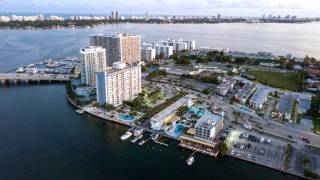
Waterfront condominiums appeal to developers looking to flip a site. Above: An aerial view of North Bay Village. |
“These buildings are obsolete because
they’re inefficient,” Zalewski said.
After the deadly collapse of the Champlain Towers South in
Surfside in 2021, developers went on a buyout frenzy. At the
time, many condo owners worried about the structural
integrity of their own buildings and were more willing to
entertain conversations to sell out.
Developers welcomed those conversations, especially for any
condominium sitting on beachfront or bayfront land. Eichner,
for example, is chasing the 12-story Four Winds Condominium
at 9225 Collins Ave., in Surfside, offering $141 million to
its 144 unit owners. “These are inherently invaluable pieces
of land,” he said.
Lehr said she now works on an average of six condo
termination deals per year in Miami-Dade, Broward, Palm
Beach and Monroe counties. Before the Surfside condo
collapse, the average had been just two or three deals per
year.
Lehr said many unit owners are concerned about where they’ll
move if they agree to a termination. It’s hard for them to
find a similarly sized residence in the same neighborhood
with the same views in today’s housing market.
“I see benefits on both sides. It’s an opportunity for those
communities unable to fund reserves and perform some of
these necessary structural repairs. At the same time, I feel
for those owners unable to stay in their homes,” Lehr said.
“Even though developers are paying a premium to purchase
units in these buildings, even with the financial gain
realized in these sales, it’s difficult for the unit owner
to get another oceanfront unit. With skyrocketing real
estate prices in Miami, it’s difficult to find something
remotely comparable.
” Some developers, Zalewski said, are now holding out to see
the impact of the structural integrity reserve studies and
if the requirement to bolster savings will push associations
and unit owners over the edge in the next two years.
“Timing is so critical. The challenge is if these people
wait too long, they might have to wait until we start
building again,” Zalewski said, referring to the end of a
five- or seven-year real estate cycle where developers slow
down developing new inventory because of an oversupply.
“It’s better to leave money on the table and then get out as
opposed to squeeze every nickel and then try to get out.”
For those looking to move forward with a condo termination —
and those who worry that a takeover of their building is on
the horizon — developers are looking for very specific
characteristics.
Here are the seven things Eichner, Lehr and Zalewski said
developers look for when zeroing in on a condo termination:
A surface parking lot
This indicates land is being underutilized. Most newer
buildings have parking garages to maximize the building’s
footprint.
Concrete balconies with railings
A condominium with concrete balconies with railings implies
the association lacks the funding to renovate and install
ones with glass, a fresh and modern look owners these days
often want.
Fewer than 100 units
Condo buyouts require 80% consensus and the explicit
objection of less than 5% of unit owners. Developers who
have attempted to buy out larger buildings have often faced
hurdles and delays because of unwilling owners, and fewer of
them are willing to enter into those negotiations.
Path of least resistance to terminate
Condo terminations can be a complicated process, and
developers like Eichner prefer if fewer votes are needed to
approve a termination.
“That’s the single biggest issue,” Eichner said, adding that
his ideal state requirement would be 75% approval needed.
The more votes required, the more likely it is that a deal
falls through because of some residents dissenting and
voting against the deal.
The submission statement in a condominium act — a document
stating the responsibilities and rights of the developer,
association and owners — will often define what percentage
of votes are needed to approve a buyout. If the document
includes Kaufman language — “as it exists on the date here
of and amended from time to time” — that means the current
law requiring 80% of approval stands. However, Lehr said, if
5% of residents come forward and vote against the
termination, then the deal can disintegrate.
That exact situation played out at Biscayne 21 in Edgewater,
spoiling what a development team believed to be a done deal.
Ever since, developers have been much more conscious in
moving forward in situations where a condominium act
requires majority approval or creates any gray area.
Zoning regulations in a given municipality
Developers prefer communities like the city of Miami,
Zalewski said, over those with more restrictions and
regulations like the city of Miami Beach. Developers often
aim to build as densely as possible to cover their costs —
land, labor, loans — and still make a profit. The more
freedom that zoning provides them, the better and more
profitable the project can be. “You’re thinking how many
units can I build, what are my profit margins, and work
backwards,” Zalewski said.
Location, location, location
Waterfront remains gold. The most preferred sites are those
on oceanfront sand, then anything on the bay on islands
connecting the mainland to the beach. Sites on the mainland
with bay views are third in the pecking order and, finally,
sites on the river such as in Fort Lauderdale’s Las Olas
neighborhood or Miami’s Miami River area.
Zalewski says that condos east of I-95 are on his radar.
“It has to do with the public, city feel. When we go west,
there’s no urgency,” Zalewski said. “People in Europe don’t
dream about having a condo in Kendall. They want to wake up
in the morning on a barrier island.”
Age matters
Developers look for buildings often at least 30 years old,
Lehr said, since it’s more likely those condominium
associations face high condominium assessment fees, special
assessments and looming reserves. Zaleswki calls these
“vintage” properties.