A Nassau County
Circuit Court judge has ordered a key opponents group in the
long-running Riverstone condominium dispute to pay nearly
$300,000 in attorney fees and costs, delivering a
significant financial setback to residents who fought one of
the most controversial development proposals on Amelia
Island.
|
In a final judgment
issued April 24, Circuit Judge Marianne Aho ruled in favor
of Riverstone Properties, LLC, awarding $291,187.53 against
the Amelia Island Sanctuary Property Owners Association.
The award includes $277,356 in attorney fees, $10,365.57 in
prejudgment interest, and $3,465.96 in costs, with
additional post-judgment interest to accrue under Florida
law.
At the heart of the dispute was the Riverstone project
itself — a large-scale condominium development approved by
Nassau County that calls for 11 mid-rise towers, each
reaching approximately 85 feet in height and 150 luxury
residential units.
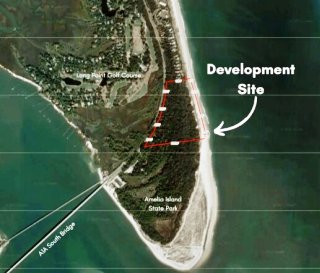
The project site sits on the south end of Amelia Island
along the Amelia Island Parkway corridor, near Amelia Island
State Park and adjacent to the Sanctuary — a low-density,
environmentally sensitive residential enclave within the
Omni Amelia Island Resort area.
The scale of the project — particularly
the height and number of towers — became the defining issue
in the years-long battle. Residents argued the development
would introduce urban-style density into an area
characterized by maritime forest, wetlands, and tightly
controlled residential uses. |
|
|
Concerns raised by opponents included increased traffic
along the already constrained Amelia Island Parkway,
stormwater runoff into nearby marsh systems, and impacts to
wildlife habitat in one of the island’s most ecologically
sensitive corridors.
The lawsuit was filed by Citizens Against Runaway
Development, the Amelia Island Sanctuary Property Owners
Association, and the Amelia Tree Conservancy, all of which
have been active in opposing large-scale development
projects on the island.
The groups challenged Nassau County’s approval of Riverstone,
arguing the project was inconsistent with the county’s
comprehensive plan and incompatible with surrounding land
uses.
County officials and Riverstone, however, maintained the
development complied with zoning and land-use regulations
and had been properly vetted through the approval process.
The case became a flashpoint in the broader debate over
growth on Amelia Island — balancing development rights
against environmental protection and neighborhood character.
The financial judgment follows an earlier court ruling in
November 2025 that found Riverstone was entitled to recover
attorney fees and costs under Florida law.
According to court filings, the parties later reached an
agreement on the amount, avoiding a scheduled evidentiary
hearing on fees.
“Plaintiffs and Riverstone have entered into a settlement
agreement to resolve the amount of the attorneys’ fees and
costs in order to avoid the additional expense of litigating
those amounts,” Riverstone’s attorneys wrote in an April 23
filing.
The plaintiffs did not contest the final amount, allowing
the court to enter judgment.
Under the order, the Sanctuary Property Owners Association
must complete a sworn financial disclosure within 45 days,
detailing assets and financial information to assist in
collection if the judgment is not paid.
The court also retained jurisdiction to pursue enforcement
actions, including garnishment and other collection
proceedings.
The Riverstone dispute had become one of the most closely
watched land-use battles in Nassau County in recent years,
illustrating the intensifying conflict between development
pressures and community resistance on Amelia Island.
For residents of the Sanctuary and surrounding areas, the
fight was about preserving the character and environmental
integrity of the island’s south end. For Riverstone and
county officials, it centered on property rights and
adherence to existing development regulations.