|
Article Courtesy of The Palm
Beach Post
By Kimberly Miller
Published September 26, 2024
|
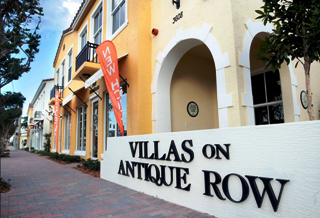
The Villas on Antique Row were heralded as a hallmark of the real estate rebound
in 2014 when they debuted on long-vacant land along South Dixie Highway in West
Palm Beach, but the celebration has soured.
A
decade after the first owners moved into the three-story townhomes fronted by
gilded antique stores, the homeowners association says residents are facing an
estimated $12.6 million in repairs, which, in a worst-case scenario, could mean
an assessment on each owner of $221,000.
|
Cracking walls,
settling pavers, corroding plumbing, rusting gates and the
erosion of load-bearing soil is alleged by the association
in a 2021 lawsuit it filed against the builder.
An April 2024 report by West Palm Beach-based Slider
Engineering Group also details structural concerns including
shrinkage in concrete and a lack of reinforcement in some
construction elements. A letter to homeowners from the
association in August notes missing rebar in walls.
“We understand the sticker shock,” the association letter
says about the high-priced repairs. “According to our
expert, the work proposed is absolutely necessary.”
But some owners said their homes don't have the same defects
as the other units — or any defects — and are protesting the
potential for an across-the-board fee that doesn’t consider
unit size or damage. Some are also dubious of the costly
repair estimate and the lawsuit itself, questioning whether
the HOA had the right to file it in the first place. |
|
The Villas on Antique Row were built on land that
once housed a Goodwill store.
|
“There are seven individual buildings, and our contention is that not all
have shoddy construction,” said Tim Johnson, who owns two shops in the
development and a townhome. “My building has no problems, but they are
treating the buildings all the same.”
The disagreements have roiled the small tree-dappled community whose
construction in 2014 was thought of as emblematic of an economy and housing
market clawing its way out of ruin. Homeowners in opposition to the blanket
fee have rallied and hired an attorney. The HOA says mediation in the now
more than 3-year-old lawsuit is scheduled for this fall and a trial set for
December if that fails.
In correspondence with owners, the Villas on Antique Row Homeowners
Association says that it would prefer to get a loan for the millions of
dollars in fixes, which would require a vote by owners of the 46 units. Two
HOA board members reached did not want to comment for this story, citing the
ongoing litigation. A message left for the HOA's attorney was not returned.
Attorneys representing the first-named defendants in the 2021 lawsuit did
not return calls for comment. Developer Harry Posin, whose company Label &
Co. built the community, declined to comment.
In 2013, however, Posin saw the opportunity that the 4-acre vacant lot along
Antique Row offered.
The land had been empty since 2006 when a Goodwill store was razed and built
anew in the 5400 block of South Dixie Highway. At the time, another
developer had plans for 82 condominiums and townhomes with about 14,000
square feet of shops. But that proposal fizzled as the real estate market
tumbled beginning in 2008.
For those who bought units during the early years, prices ranged between
about $320,000 and $490,900. Antique Row, which is roughly between Southern
Boulevard and Belvedere Road along South Dixie Highway, was seeing signs of
a revival in those days with new stores being built, such as the two-story
Cedric Dupont Antiques, and new restaurants including the popular City
Diner.
In recent years, with a swell of pandemic-spurred home buyers, selling
prices for individual townhomes at the Villas on Antique Row have been as
high as $1.3 million, according to the Palm Beach County Property Appraiser.
Johnson joined with several other owners in hiring an attorney to, in part,
negotiate with the association on the potential $221,000 fee.
He said he fears people will have to move out of their homes during the
repairs, which the HOA in its letter predicted will be “invasive, loud,
dusty, disruptive and costly.”
Attorney Frank Lynch, who is working with the homeowners opposing the costly
assessment, said the HOA overstepped when it suggested everyone share
equally in the repair costs when some buildings show little or no damage.
“The repairs do not serve the members as a whole but address specific
members and their properties,” he wrote in a letter this month to the HOA.
“In many cases, the assessment contemplated on a per unit basis exceeds the
purchase price of those units.”
Individual stores, which sit below carriage house-like townhomes, cost as
little as $150,000 when they were newly built.
Michael Gelfand, a West Palm Beach attorney who specializes in real estate
and association law, said the rules on paying for repairs should be spelled
out in the HOA declaration of covenants, which outlines individual owner
obligations.
Although dull, he recommends prospective buyers in HOA communities review
the covenants before signing a deed. He said unlike condominiums that have
statutory guidance on repair language, developers of HOA communities can
write their own rules.
“Generally, if the declaration is silent, then each owner is responsible for
what they own, they are not responsible for other units,” said Gelfand,
noting that construction defect concerns are not unique to the Villas on
Antique Row. “This is happening at all price points.”
Lynch points to the declaration for the Villas on Antique Row as evidence
that his clients are not responsible for damage at other units. He maintains
that the contract says work related to construction defects should be the
subject of an individual assessment on the unit owner. To further complicate
issues, Lynch says an HOA-approved amendment to the declaration that spread
costs burdens across the community did not meet the legal requirement of
being approved by all HOA members.
"My clients are not litigious by nature, but feel that their rights are
being steamrolled," Lynch wrote in the letter to the HOA.
The HOA says it is confident it will win its lawsuit, which after more than
three years now names multiple subcontractors as plaintiffs.
“We are equally disappointed and upset over the magnitude, time and expense
inconvenience, and costs to properly fix the defects in our community,” the
board wrote in its August letter. “Nevertheless, we are confident that this
repair process will enable us to recapture our long-term market values."
|