The downtown Miami skyline will continue to change with the approval of a 75-story luxury condo tower at a historic church on a slice of bayfront land.
|
A Miami Herald file photo from 2018 shows the First Miami Presbyterian Church. |
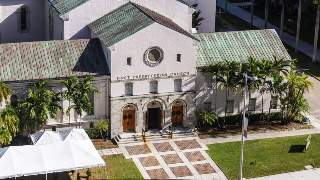
“We appreciate the Historic and Environmental Preservation Board’s careful consideration of all the information presented and its ultimate decision to preserve the historic 1949 sanctuary, enabling the church to serve future generations,” Olivia Klein, a spokesperson for 13th Floor and First Miami Presbyterian, told the Miami Herald. “We look forward to advancing the project and bringing this vision to life.”
How we got here
This isn’t 619 Brickell by Nobu’s first time seeking the
board’s approval — or getting it.
Over the past two years, the historic status change has been
approved by the board and city commissioners. But
neighboring Brickell residents have pushed back, concerned
about noise, pollution and damage to nearby Mary Brickell
Park.
“Traffic is going to be an issue and the deforestation of
the trees in the area,” said Ernesto Cuesta, president of
the Brickell Homeowners Association.
The neighborhood association is a community group that
includes about 60 condo associations and other entities in
the area, including First Miami Presbyterian.
Residents of the Icon Brickell II — a luxury high-rise about
a half-mile from the church along the northwest side of Mary
Brickell Park — have also become one of the project’s
staunchest opponents.
When city leaders signed off on the development in 2024 and
2025, the tower’s condominium association objected and
listed its concerns.
They were told the same thing each time: Icon Brickell II
had no standing to intervene. The condo association followed
by asking Miami-Dade circuit court to review Miami’s
argument.
In August, three judges ruled to undo the city’s previous
approvals to strip the church’s school and parking lot of
the historic status, adding that Icon Brickell II’s
residents were wrongly shut out of the decision.
They cited city code, which says property owners within 500
feet are allowed to intervene. Icon Brickell II is about 160
feet away.
Miami appealed in October and lost, forcing a redo vote at a
Nov. 3 preservation board meeting where officials ultimately
approved the project.
“I don’t blame the developers,” Cuesta said. “Developers are
there to make money, to make profits. It’s the city, it’s
our leaders, the ones that have been elected by us, that
have to defend the quality of life of the residents.”
Neither the city of Miami nor the spokesperson of its
preservation board, Ken Kalamis, have responded to the Miami
Herald’s request for comment as of Nov. 6.
The hearing and development communications
Why did the church’s school and parking lot have landmark
status in the first place?
Most historically designated buildings share their rights
and protections with the parcel of land they sit on, not
just the structure itself, according to Fort Lauderdale
attorney Ryan Abrams. Abrams represented Icon Brickell II’s
association during the Nov. 3 hearing.
That means that any “contributing structures” on the land —
which city code says can include buildings, landscape
features, sites or objects — are also dubbed historically
significant.
At the Nov. 3 hearing, 13th Floor and the church argued that
because the school’s annex and parking lot were added after
1950 — dubbed the “period of significance” — it couldn’t
share in the sanctuary’s landmark status. The church
building was completed in 1949.
First Miami Presbyterian’s annex was home to Key Point
Academy Downtown until last year. The school relocated to
Downtown’s Omni Center, 1501 Biscayne Blvd., in August.
Icon Brickell II countered that while the school and parking
lot were built in phases, both were always part of the
church’s original plan to offer more amenities to its
growing congregation.
What kept First Miami Presbyterian from being completed all
at once was the church’s tight budget, said Miami historian
Casey Picket. Picket, who spoke at the Nov. 3 hearing at the
condo association’s request, runs a blog and podcast and
co-authored a book about Brickell’s history.
Picket told board members that other, protected features of
the church’s sanctuary — a second-floor office space, a
library, the Celtic cross perched on its steeple — were
added on later as well.
But Icon Brickell II resident aren’t just upset about seeing
First Miami Presbyterian dwarfed by a skyscraper.
The association and Cuesta are also frustrated with what
they say has been too little information about the project.
Both also say the church has failed other moneymaking
opportunities rather than a big building on the property.
First Miami Presbyterian could earn about $240 million from
the sale, welcome cash for a congregation that’s faced
financial challenges over the past decade.
The church could sell its “air rights,” suggested Alan
Barson, a member of Icon Brickell II’s association board.
Transferring air rights could allow developers to builder
higher and denser elsewhere.
“Why didn’t they apply for grants since they’re a historic
landmark?” said Cuesta. “Why didn’t they go and fundraise?”
Cuesta also said that the developers’ silence is largely the
church’s work. He says the firm told him they refrained from
talking with concerned residents because of a nondisclosure
agreement with First Miami Presbyterian that left the church
responsible for engaging with the community.
First Miami Presbyterian Church’s pastor, the Rev.
Christopher Benek, has not responded to the Miami Herald’s
request for comment.
What’s next?
No other approvals are required by the city of Miami,
meaning 13th Floor can begin its work on 619 Brickell by
Nobu.
City code allows for a 60-day period in which an appeal
could be made to commissioners. The Icon Brickell II
neighbors say they haven’t decided their next move.
“This is not over, this is just one step. We’re looking at
all the options, but there’s going to be more ahead,” said
Abrams, Icon Brickell II’s attorney.
Meanwhile, 13th Floor says its timeline for 619 Brickell by
Nobu remains unchanged despite the years of litigation and
pushback.
Completion of the 75-story skyscraper — a residential
offshoot of hospitality and dining brand Nobu, which has
towers in Mexico and Toronto and a hotel in Miami Beach,
among other properties — is slated for late 2030 to early
2031, according to the firm.
Plans for the ultra-luxury Nobu condo building, where unit
prices range from about $3 million to $60 million, include a
Nobu restaurant and a wellness suite.