|
Article Courtesy of
The Palm Beach Post
By Mike Diamond
Published August 4, 2026
|
Pickleball's explosive growth is fueling conflict in Palm Beach County
neighborhoods, where homeowners are suing their associations, organizing recalls
and battling over plans to expand courts near their homes.
Residents in two gated communities have filed lawsuits over pickleball noise,
while those in a third community are trying to recall board members who approved
plans to convert a tennis court into four pickleball courts.
|
Homeowners say the sport's distinctive
and loud "pop" noise is disrupting their quality of life
while HOAs say they are responding to overwhelming demand
for courts and access to play what has been described as
America's fastest-growing sport.
The first pickleball-noise lawsuit in the county, reported
by The Palm Beach Post earlier this year, was filed against
Parkside at Boca Trail in Boca Raton.
Plaintiff Richard Kitt, who lives about 70 feet from the
courts, says the sound is so intrusive that "it is like they
are playing in my kitchen." According to court filings, the
HOA's own acoustical study found pickleball noise exceeded
Boca Raton's daytime limits.
The Parkside lawsuit is expected to go
trial in September. It could set a statewide precedent.
While the homeowner association at Parkside Trail at Boca
Raton has declined to comment on the lawsuit filed against
it, the HOA claims in court filings that it is permitted to
change the makeup of its recreation center, noting residents
were well aware that they purchased a home adjacent to the
recreation complex, and that some day its makeup could
change.
|
|
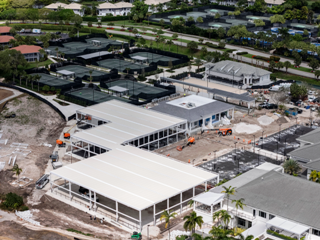
A $20 million pickleball facility is under
construction and will include 25 courts and 12 covered and stadium.
Tennis center will have a stadium court.
|
How late is too late for pickleball court noise?
More recently, homeowners at Polo Trace, west of Delray Beach, filed a lawsuit
to stop pickleball play. Keith Grumer, a Weston-based attorney, represents
homeowners at both Boca Raton communities.
“What is unusual about Polo Trace is that they opened their courts for use to
the public,” said Grumer. “As a result, play is constant and can occur as late
as 11 p.m. They (the board) did this without a community vote."
At Polo Trace, the four pickleball courts are within 100 feet of homes. And the
HOA is looking to take away a tennis court to add four more pickleball courts.
All of the courts are too close to homes, according to the lawsuit, which says
that the board failed to conduct a study to determine if the noise from play is
a nuisance.
One Polo Trace resident, who asked not to be identified, said play sometimes
starts at the crack of dawn. The homeowner said he and his family have been
harassed and accosted by pickleball players who support the addition of the four
more courts.
Efforts to obtain comment from the HOA at Polo Trace were unsuccessful. But in
an email to residents in May, the HOA reported that the lawsuit "may affect the
anticipated timeline" for the conversion of the tennis court into four
pickleball courts.
Doug Fight plays pickleball several times a week at Polo Trace. He called the
lawsuit "frivolous." He said there is a clear demand for the additional courts.
Meanwhile, Grumer said pickleball noise has become a specialty of his law
practice. “I’m getting calls all the time from folks who say pickleball noise
affects their quality of life. This is all becoming, unfortunately, very ugly.”
Kitt said the noise issue has split apart the community at Parkside. Since the
lawsuit was filed, he said he has been harassed and some residents who were his
friends no longer speak with him.
At Crescent Lakes, Monika Mazgal is leading a recall movement to remove board
members who approved a contract to convert tennis courts into pickleball courts.
She, too, has consulted with Grumer but says at this point she cannot afford to
sustain the litigation costs.
“We have more than 100 signatures of people opposed to what the board wants to
do,” Mazgal said. “That is about half the community. Still, they seem to want go
ahead with it despite the widespread opposition.”
The Crescent Lakes Homeowner Association notified residents a year ago that it
would be closing the community’s two har-tru tennis courts because they were too
expensive to maintain. Four pickleball courts would be built to accommodate the
demand for the game.
Mazgal says some of the pickleball courts will be within 10 feet of her home.
She argues that the community should have been given the opportunity to vote on
the issue. Efforts to obtain comment from Crescent Lakes were unsuccessful.
Residents opposed to the Crescent Lakes' project protested during a meeting on
July 7, calling for the board to reverse its decision and for three board
members to resign. After hearing out residents for more than an hour, Mazgal
claims the board abruptly ended the meeting without responding to residents'
comments.
“They (the board) won’t listen to people like me who live four steps from the
courts. There is no plan to install sound barriers or perform sound testing,”
Mazgal said. “Homeowners are being forced to financially underwrite the
destruction of their own community amenities.”
The Mor-Sports Group, based in Estero, Fla., builds pickleball courts across the
state. On its website, though, it warns HOAs to be aware of “the science behind
pickleball noise” to protect their communities from costly disputes.
“The noise difference between pickleball and tennis isn't subjective,” said the
company on its website. Pickleball generates approximately 70 decibels compared
to tennis at 40-45 decibels, making it significantly louder than the sport it's
often replacing on community courts, the company added.
In both lawsuits in Boca Raton, Grumer is seeking temporary injunctions to stop
pickleball play while the case proceeds to trial. Lawsuits challenging
pickleball noise have also been filed in Naples and another in Hillsborough
County in Apollo Beach, where residents compared the sound to "a pneumatic nail
gun on a roof." |